
First Coast Property Experts
St. Johns County Luxury Home Trends: 2026 Outlook
ST. JOHNS COUNTY LUXURY HOME TRENDS: WHAT 2026 LOOKS LIKE FOR ESTATE OWNERS
St. Johns County has become one of the fastest-appreciating luxury markets in the Southeast. Here is what the estate-level homeowners we serve are doing in 2026 — and what it tells us about where the market is heading.
St. Johns County — specifically the Ponte Vedra Beach, Nocatee, Palm Valley, and St. Augustine corridors — has been quietly rewriting the luxury home definition in Northeast Florida for a decade. 2026 is the year several long-building trends are crystallizing into a coherent picture of what the next-generation NE Florida estate looks like.
We have a unique vantage point on this. Our field specialists maintain the exteriors of over 600 residential properties in the county, with more than a century of combined expertise watching what estate-level owners actually invest in versus what trend pieces claim they invest in. Here is what the 2026 data and our on-the-ground observations tell us.
H2: Outdoor Living Is the Primary Square Footage Investment
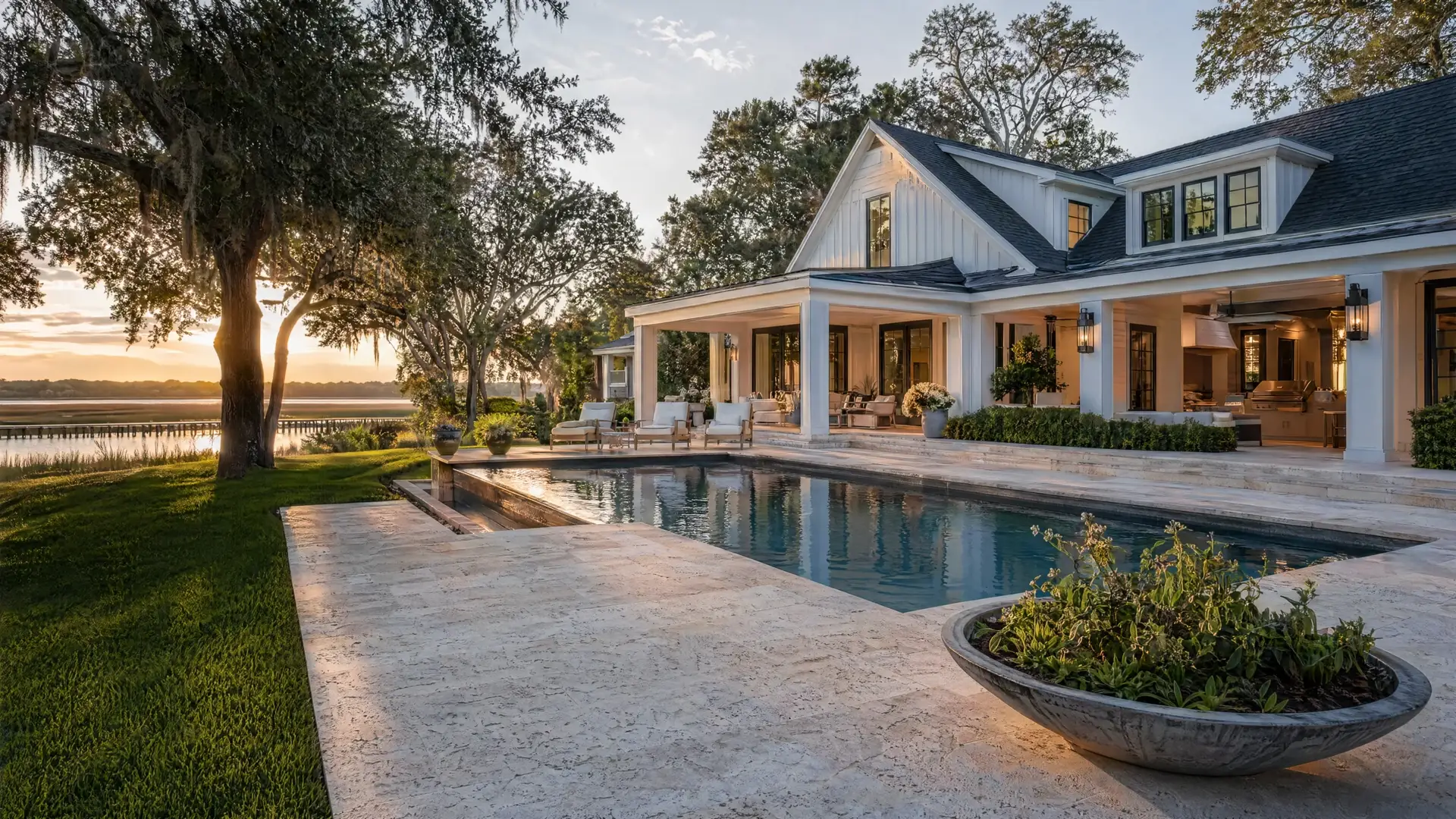
Ten years ago, a luxury home renovation budget went mostly to the interior — kitchen, primary suite, wine room. In 2026, the single largest renovation category on St. Johns County estates is the outdoor living envelope: covered lanais, outdoor kitchens, pool refresh or expansion, and landscape architecture.
What we are seeing drives real numbers:
- Hardscape — paver patios, travertine pool decks, stone retaining walls, fire features — has become the single largest line item on many luxury remodels, often exceeding kitchen renovation budgets.
We set the standard. We will not be the cheapest. The right scope is established on the property, then written around its material, condition, access, and the level of care it deserves. Request your quote.
H2: The Shift from One-Off Services to Annual Maintenance Programs
Ten years ago, an estate-level client might have called a pressure washer once every 3-4 years to “clean up the exterior.” In 2026, that same client is increasingly on a scheduled annual or biannual maintenance program that bundles softwashing, paver maintenance, sealing cycles, window cleaning, and screen care into a single relationship with a single provider.
The reasons for this shift:
- Scheduling complexity. Coordinating six different one-off vendors for softwash, pavers, windows, screens, and pool is real work. Bundling simplifies.
- Quality control. A single provider with a single quality standard across all exterior surfaces produces a uniform result that a rotating cast of one-off vendors cannot.
See our annual maintenance plans page for the framework we use with estate clients.
H2: Smart-Home Integration Is Moving Outside
Interior smart-home is mature. What is new in 2026 is smart-home integration outside the envelope:
- Connected irrigation that adjusts based on rainfall sensors and soil moisture, saving water and reducing over-watering damage to pavers and stone.
- Outdoor lighting scheduled and zoned through a central controller — no more dusk sensors that fail individually.
- Pool automation that ties chemistry, temperature, pump cycles, and fill-level to a single app.
- Security integration that unifies front-entry, gate, garage, and outdoor cameras into one interface.
What this means for maintenance: our crews now need to know where sensors are, how to work around them, and when to notify homeowners before triggering a zone. It is not technically demanding, but it is a new vocabulary for exterior service.
H2: The Material Shift — Travertine and Bluestone Over Concrete
Five years ago, most high-end pool decks in St. Johns County were stamped concrete or concrete pavers. In 2026, the dominant choice on new construction and major renovations is natural stone — travertine in the warmer earth tones, bluestone in the formal settings.
Why the shift:
- Longevity. Properly maintained travertine outlasts concrete by decades.
- Aesthetics. Natural stone ages into beauty; concrete ages into liability.
- Resale value. Appraisers now comp travertine and bluestone at meaningfully higher values than equivalent concrete installations.
- Heat. Light travertine runs 15-20°F cooler than gray concrete in direct sun — a real comfort difference on a Florida pool deck.
The maintenance implications are significant. Travertine and bluestone need softwashing (never pressure washing) and require sealer products and techniques specifically engineered for natural stone. See our travertine sealing and bluestone sealing service pages for the specifics.
Natural stone is the 50-year investment. Every estate owner we work with on a new build in 2026 is specifying travertine or bluestone. The maintenance program is what keeps that investment intact.
H2: Hurricane Resilience Is Now Table Stakes
2024 and 2025 reminded every Florida homeowner that storm resilience is not optional. In 2026, luxury home upgrades increasingly include:
- Impact-rated windows and doors throughout (not just primary rooms).
- Standby generators sized for the full home, not just critical loads.
- Reinforced pool cages rated for higher wind loads.
- Hardscape that drains and survives — which means properly installed, properly maintained pavers with intact joints and proper base prep.
The paver drainage question is worth emphasizing. A properly installed and maintained paver patio with angular joint sand and intact sealer drains effectively even in tropical-storm-level rainfall. A neglected paver patio with eroded joints and biofilm-clogged pore structure holds water on the surface, which becomes a real problem during sustained high-wind rain events.
The Environmental Protection Agency has published extensive guidance on permeable hardscape and stormwater management that is directly relevant to pool-deck and patio design in hurricane-prone Florida.
H2: The “Quietly Luxurious” Aesthetic Is Winning
The showy 2010s luxury aesthetic — oversized chandeliers, heavy ornate molding, faux-Tuscan stucco — has given way to what we call “quietly luxurious” in 2026. The visual cues:
- Neutral exterior color palettes — warm whites, soft grays, and desaturated earth tones.
- Matte or low-sheen sealers rather than high-gloss wet-look.
- Simpler landscape design — fewer plant varieties, more curated repetition.
- Thoughtful lighting — warm color temperatures (2700K-3000K), dimmable, zoned.
- Invisible maintenance — every surface looks like it just happened to look that way, which of course it did not.
The maintenance implication: the sealer choice now matters as much for aesthetic restraint as for performance. Where an estate might have specified wet-look a high-sheen finish system five years ago, today they are often specifying the selected breathable sealer system for the matte-to-low-sheen finish. See Request your quote for the property assessment.
H2: What This Means for the Estate Owner in 2026
If you own an estate-level home in St. Johns County, the meta-trend is clear: exterior investment now equals or exceeds interior investment for many homeowners, and that exterior investment needs a proportionate maintenance program to hold its value.
Our recommendation: build a calendar. Not a spreadsheet, not a gut feeling — a scheduled calendar of softwash cycles, sealer renewals, screen care, and window cleaning that runs automatically without you having to remember to call. Estate-level clients we work with typically review the calendar once a quarter and approve it forward; the work happens without cognitive overhead.
H2: The Gold Standard Guarantee
Interested in a maintenance program that protects your estate’s exterior investment? Request a consultation and we will walk your property, document current condition, and build a calendar that runs on autopilot.
Questions? Email info@firstcoastpropertyexperts.com or call (904) 466-1622.
More from the FCPE Journal
- Complete Home Exterior Maintenance Schedule for Northeast Florida
- Guide Florida Home Maintenance
- How to Choose a Property Care Company: 9 Questions
The service behind this guide: The Seasonal Exterior Cleaning Calendar
