
First Coast Property Experts
Pool Deck Slip-Resistance: The One Additive We Never Skip
WHY POOL DECK SLIP-RESISTANCE MATTERS IN FLORIDA — AND THE ONE ADDITIVE WE NEVER SKIP
A ten-minute read on wet-surface safety, Florida pool-deck code, and the grit additive that quietly keeps families from the ER.
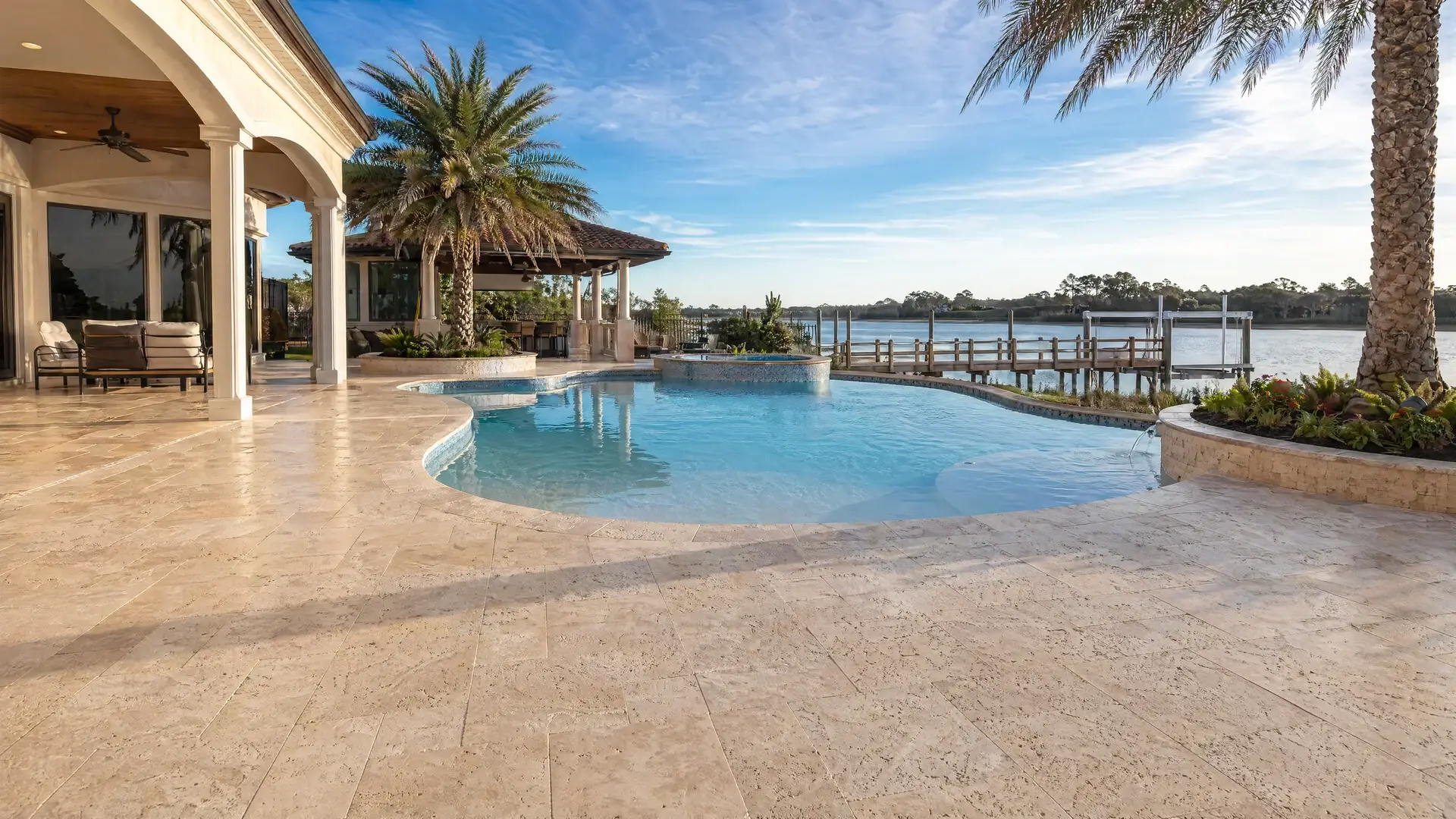
Florida estate owners think about pool decks the way everyone else thinks about cars — they think about how they look. The color, the pattern, whether the travertine pops after a reseal, whether the coping matches the Nocatee neighbors. What almost nobody asks us about is the coefficient of friction on their wet pool deck. That is the number that actually matters on August afternoons when kids are racing wet-footed around a pool at a birthday party.
This is the post we write because the cost of getting this wrong is not financial. It is medical. A slip-and-fall on a wet pool deck is one of the most common serious accidents on a Northeast Florida property, and almost every one of them is preventable with a decision made at the sealing stage.
THE COEFFICIENT OF FRICTION — THE NUMBER THAT ACTUALLY MATTERS
Every surface has a coefficient of friction, often abbreviated COF. Dry, it does not matter much. Wet, it is the difference between a safe deck and a hospital visit. The Centers for Disease Control and Prevention tracks slip-and-fall injuries as one of the top causes of nonfatal injury in the United States, with wet surfaces around residential pools representing a significant share.
The American National Standards Institute has historically published wet-surface COF guidance placing 0.42 as the floor for safe walking surfaces. A freshly sealed, glossy travertine pool deck without an anti-slip additive will frequently test below that when wet. You can feel it yourself — it is the skating-rink sensation the first time you step on a newly sealed deck after a pool splash.
The additive changes that number. Measurably. Documentably. Every time.
WHAT THE ADDITIVE IS AND WHY WE NEVER SKIP IT
The additive is a micronized polymer grit — typically aluminum oxide or a proprietary polymer equivalent — suspended in the final coat of sealer. On a properly specified pool deck job, we add it to the final coat only, not the base coat. The grit embeds into the surface layer as it cures, creating micro-texture that you cannot see from standing height but that your wet foot feels immediately.
Without it, a sealed travertine or paver pool deck can lose as much as 40% of its wet-surface grip compared to unsealed. With it, the sealed deck is typically grippier when wet than the raw stone was when new. That is the point. That is the entire reason we do it.
We never skip it on:
- Pool decks of any material
- Outdoor shower surrounds
- Stair treads exposed to rain
- Any transition zone within six feet of a water feature
- Lanai floors that receive pool splash-over
We will discuss skipping it on:
- Covered interior loggias with zero water exposure
- Dry decorative walkways well away from the pool
The default is always: add it.
FLORIDA RESIDENTIAL POOL CODE — WHAT HOMEOWNERS SHOULD KNOW
Florida’s residential pool code and the National Swimming Pool Foundation guidance both emphasize slip-resistance as a design parameter for pool decks, particularly in areas subject to frequent wetting. While residential code enforcement varies by county, the exposure is the same: a slip-and-fall on your pool deck is a property-liability question, and an insurer investigating a claim will ask whether you made reasonable efforts to maintain slip-resistance.
Adding grit to the sealer is a reasonable effort. Documenting it in your service records — which we do for every FCPE pool deck job — is an even better one.
THE VISUAL TRADE-OFF — HONEST ANSWER
Homeowners sometimes ask if the additive changes how the pool deck looks. Honest answer: barely. On a natural-finish sealer, the additive is invisible from standing height. You can feel it barefoot if you look for it. On a high-gloss wet-look sealer, the additive slightly dulls the mirror finish — which is one of the reasons we strongly recommend natural or satin finishes on pool decks rather than full gloss. A mirror-gloss pool deck is a marketing photo; a satin pool deck with grit is a safe family surface.
If a homeowner absolutely wants gloss, we will still use the additive. The deck will still look beautiful. It will just be safe.
The sealer on a pool deck is not a cosmetic product. It is a safety product that happens to also look good when the job is done right.
THE GOLD STANDARD GUARANTEE CALLOUT
The Gold Standard, Every Time. Every FCPE pool deck sealing project includes our anti-slip additive in the final coat at no extra charge on standard-scope jobs. We do not treat it as an upsell. We treat it as part of doing the job right. If a sealed pool deck tests below reasonable wet-surface grip within our warranty window, we reapply at no charge.
WHAT CAN GO WRONG IF YOU SKIP IT
We have been called to a number of pool decks in Ponte Vedra, Nocatee, and World Golf Village where the prior contractor did not use grit. Three patterns come up repeatedly:
- The family slip within sixty days of seal — a child or grandparent slips on the newly sealed deck after the first pool day, and the homeowner calls us to strip and reseal with grit
- The insurance-claim inquiry — an insurer investigating an unrelated claim asks for records of deck maintenance and wet-grip testing
- The selling-the-house surprise — a home inspector flags the sealed-but-slick pool deck on a buyer’s inspection, forcing a reseal before closing
All three are avoidable with a ninety-dollar additive on the front end.
WHY THIS IS A CONVERSATION WE WISH MORE HOMEOWNERS HAD
Most Northeast Florida pool contractors and deck installers will not bring up slip-resistance unless the homeowner does. Sealing contractors are the same — if the customer does not ask, many will not volunteer. The result is thousands of pool decks across St. Johns and Duval counties that are sealed, shiny, and measurably slicker than they were before.
We bring it up on every pool deck estimate. Every one. It is in the scope before you ever see a number.
WHERE POOL DECK SEALING FITS IN A FULL EXTERIOR PLAN
Pool deck sealing is almost always part of a larger exterior package on estate properties. If you are considering a reseal, you are probably also thinking about the driveway, the lanai pavers, and possibly a softwash of the pool cage. Our paver sealing service page covers the full scope, and our exterior services hub explains how pool-adjacent work coordinates with softwashing, cage cleaning, and tile-and-grout work.
MORE THAN MORE THAN A CENTURY OF COMBINED EXPERTISE ON POOL DECKS
Our team carries more than a century of combined expertise on Northeast Florida pool decks specifically. We have sealed travertine, shellstone, concrete pavers, clay pavers, stamped concrete, and flagstone surrounds across every major St. Johns and Duval community. We have also been called back to strip the wrong products off decks sealed by contractors who did not know any better. The one common thread on the decks we never have to strip: the anti-slip additive was specified on the original job.
READY FOR A SAFER POOL DECK BEFORE SUMMER?
Every FCPE pool deck quote includes the anti-slip additive in the final coat as standard scope. You will see it in writing on your estimate. You will see it called out on your invoice. You will feel the difference the first time a grandkid runs across a wet deck and does not go down.
Request your free pool deck assessment →
More from the FCPE Journal
- Travertine Pool Deck Maintenance Guide for NE Florida
- Green Pool Recovery in Northeast Florida
- Pool Deck Cleaning and Sealing: The Complete Florida Guide
The service behind this guide: Pool Deck Restoration & Sealing
