

St. Johns · Duval · Nassau · Year-Round
The Northeast Florida Exterior Cleaning Calendar.
The Gold Standard, Every Time.
Florida growth never sleeps. Mildew, algae, lichen, pollen, and salt drift run on a four-season schedule that most homeowners never see — until the schedule catches up to them. There is a calendar. Here’s how to match it before the calendar starts costing you money.
The Growth Cycle Here
Four climates in one zip code, on rotation.
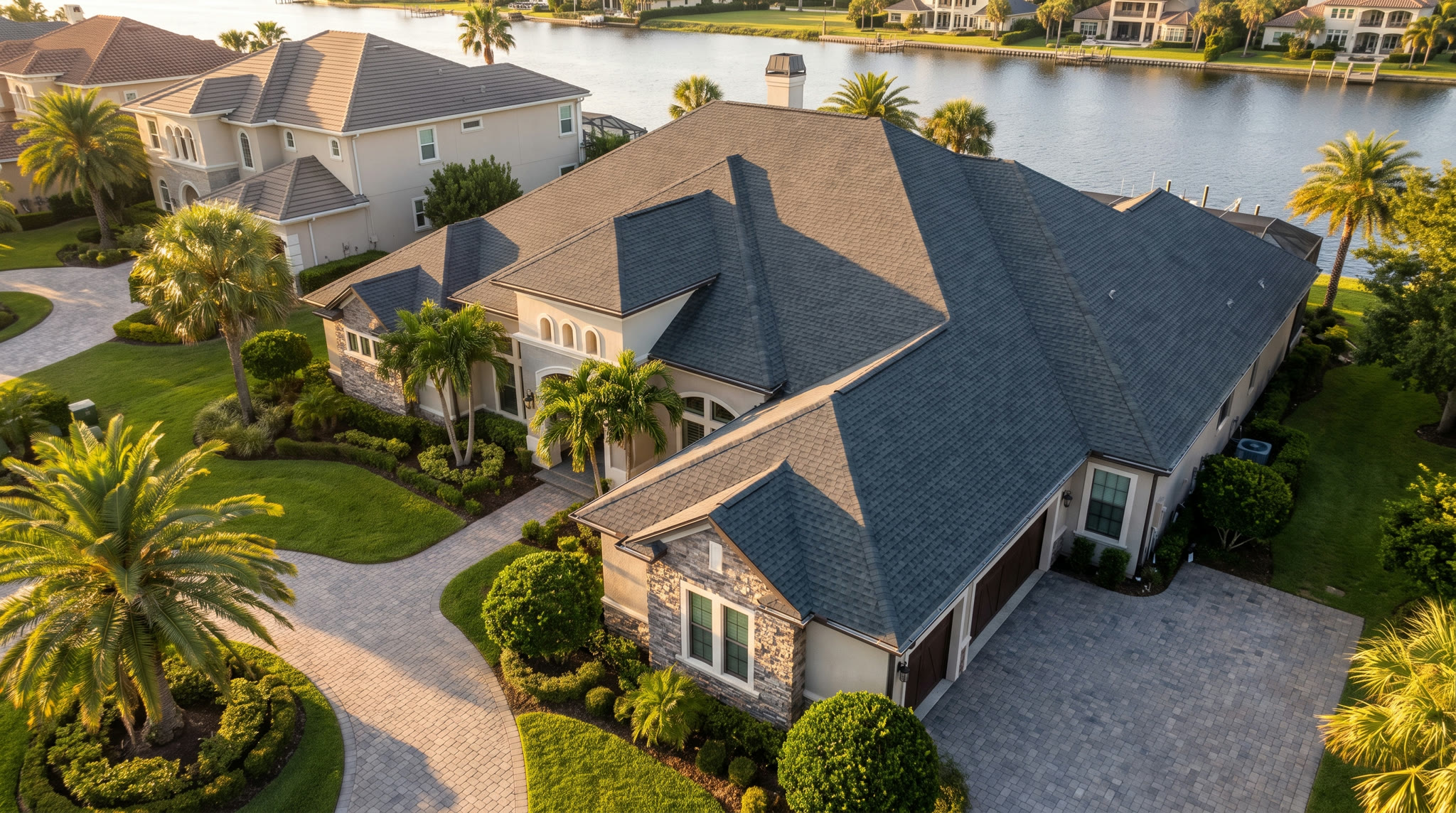
A Northeast Florida calendar year cycles through four distinct micro-climates — and each one drives a different kind of organic growth on the exterior of your home. Spring delivers an algae bloom on every north-facing surface that held moisture through winter. Summer turns up the heat and humidity to lichen-and-mildew levels — particularly on roofs, fences, and shaded siding. Fall layers pollen on top of mature lichen colonies, gluing the whole stack to your eaves and windows. Winter cools just enough to set the stains rather than grow them — so what you didn’t clean by December tends to harden into the surface until spring.
Most homeowners don’t notice the cycle. They notice the result — a roof streak in May, a green driveway by July, an oxidized window frame by October — and they call us at the moment of frustration. By then we’re cleaning the cumulative load of three quarters of growth at once. That’s a more expensive job, a longer job, and a job where the underlying surface has often taken some structural wear that a quarterly rhythm would have prevented entirely. The calendar matters. Here’s what each quarter brings.
Quarter by Quarter
What’s growing — and what to clean — month by month.
Q2 — Apr · May · Jun
Spring Algae Bloom
- House soft-wash — north and east elevations are the fastest-growing zones. Algae establishes in 3-4 weeks of warm humid weather.
- Driveway and walkway clean — winter stains are still soft, lift cleanly before summer bakes them in.
- Roof soft-wash if last cleaned 3+ years ago — bloom shows through by May.
- Pollen rinse on windows and screens — late April once the oak catkin drop is done.
- Pool deck soft-wash — get the green out before pool season hits.
Q3 — Jul · Aug · Sep
Summer Mildew & Lichens
- Pool cage softwash — black mildew on the screen frame and inside corners shows up here.
- Fence and deck wash — wood is at its softest in summer humidity, easiest to clean without grain damage.
- Lichen treatment on shaded siding and roof — lichen is mature by August, requires longer dwell to lift.
- Gutter clean before hurricane season peaks — clogs become flooding during a Category storm.
- Paver re-sand inspections — heat expansion shows joint failures before fall rain washes them out.
Q4 — Oct · Nov · Dec
Fall Pollen + Mature Lichen
- Whole-house soft-wash — pre-holiday clean, removes the summer lichen mature crust.
- Driveway sealant wash and re-seal — concrete is cool enough for sealer to cure correctly.
- Paver sealing and re-sand — joint angular sand sets best in dry shoulder-season weather.
- Window cleaning — fall pollen plus summer storm spotting comes off with a single cycle.
- Gutter clean post-leaf-drop — late November once oaks finish dropping, before winter rain.
Q1 — Jan · Feb · Mar
Winter Stain-Set Window
- Concrete sealing on driveways and walks — cool dry weather is ideal for cure cycle.
- Sealing & sanding on pavers — joints set hard before spring growth pushes through.
- Light maintenance washes on patios and lanais ahead of spring entertaining.
- Soft-wash on early-blooming north elevations — knock down pre-spring algae before it explodes.
- Annual exterior planning visit — set the year’s recurring schedule with the calendar locked in.
Recurring vs. One-Off
What changes when the calendar is locked in.
A homeowner who calls us once a year — typically in April when the spring bloom is undeniable — gets a one-off whole-house soft-wash. We solve the visible problem, document everything, and leave. It’s a good service, the home looks great when we drive away, and the homeowner’s satisfaction is high. But by November the lichen is back on the north elevation, the gutters are loaded, the pool cage is mildewing, and the cycle is starting again — only this time with a head start because the spring wash didn’t address the slower-burning problems on the calendar.
We set the standard. We will not be the cheapest. The right scope is established on the property, then written around its material, condition, access, and the level of care it deserves. Request your quote.
Lighter Per-Visit Load
A clean surface stays clean with a quarterly maintenance pass. The chemistry runs gentler, the dwell runs shorter, the rinse uses less water. Surfaces last longer because they aren’t being treated for cumulative damage — they’re being maintained.
Calendar Discipline
The right service in the right quarter. Concrete sealing in winter when cure conditions are right. Paver re-sand in fall before rain. Roof soft-wash when bloom is detectable but not mature. The plan does the calendar thinking — the homeowner doesn’t.
Predictable Cost
One annual amount, billed monthly, with the work pre-scheduled. No surprise spring “the roof is awful” panic call. No mid-summer “fence is green” emergency. The cost is known. The schedule is set. Same standards every visit, year over year.
The Tipping Point
Year four is when neglect starts charging interest.
A house in Northeast Florida that gets no exterior maintenance for one year usually looks worse but cleans up well. By year two, the owner notices. By year three, neighbors notice. Year four is the inflection point — the year when the cumulative biological load on the home shifts from “cosmetic” to “structural.” Granules are being eaten off the roof. Joint sand is washing out of the pavers. Paint and stain are absorbing the algae rather than repelling it. The fence wood softens. The driveway sealant is gone — and concrete is now soaking up oil, rust, and tannin stains directly into the porous surface, where they set permanently. Year five and beyond, the math gets ugly fast.
Year One — Recurring Care
Annual exterior plan billed monthly. House soft-wash, roof on the correct interval, driveway maintenance, gutters twice, paver re-sand on schedule. Surfaces stay sound — the next year’s plan picks up where this one left off, on a maintenance trajectory rather than a recovery one.
Year Five — Restoration
Heavy roof soft-wash with extended dwell. Driveway concrete-strip and re-seal (the original sealer is gone). Paver re-sand and full re-seal. Fence-wood restoration or partial replacement. Window-frame oxidation removal. And in some cases — accelerated roof or fence replacement on a timeline 5-10 years early. About 3x the cost of staying on the calendar from the start.
The trade-off isn’t subtle. Recurring care runs at a predictable cost, on a calendar that matches the climate. Restoration runs at multiples of that cost, with structural surfaces that have already lost years of life on them. The decision usually isn’t whether to clean — it’s whether to clean on a schedule, or pay later for cleaning catch-up plus the wear that ran underneath the dirt for four years.
The Calendar Locks With A Plan
Match the climate. Beat the cycle.
More than a century of combined expertise in Northeast Florida exterior care. The annual exterior plan locks the calendar in for you — right service, right quarter, every year. Same standards every visit. Serving St. Johns, Duval, and Nassau Counties.