


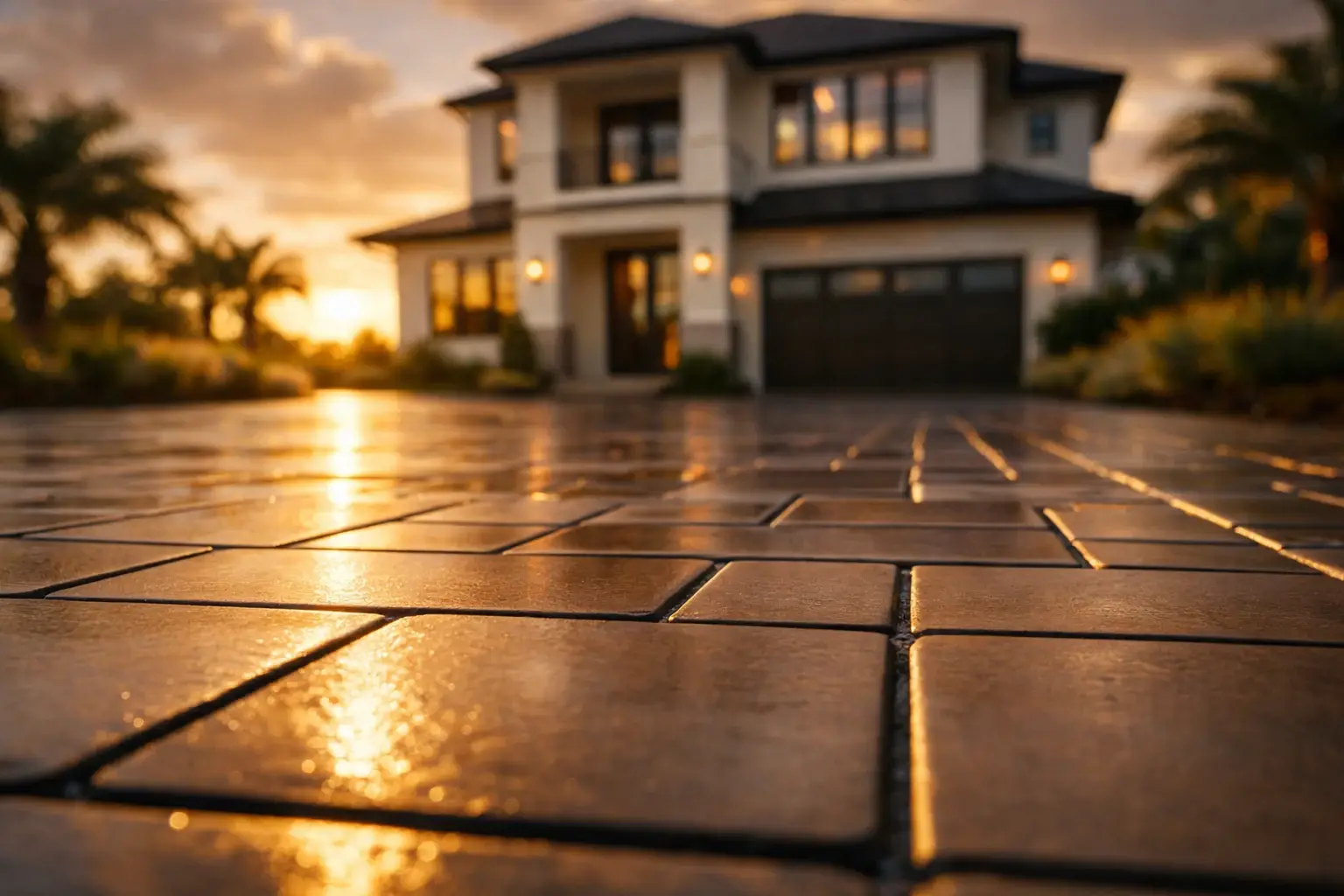
Stamped concrete sealing & color restoration.
Stamped concrete is one of the most visually striking hardscape surfaces in Northeast Florida — embossed patterns, integral color, and decorative borders that mimic high-end stone or brick at a fraction of the cost. But that visual value comes with a maintenance obligation most homeowners underestimate until their once-vivid stamped patio turns chalky, gray, and peeling. Our stamped concrete process restores the color depth, locks in the texture, and protects the investment for 3–5 years. Fully guaranteed.
Stamped concrete fails dramatically when it fails.
Standard flat concrete fails predictably: surface wear, minor cracking, light efflorescence. Stamped concrete fails visibly — and dramatically. Every groove, ridge, and embossed texture is part of the visual value of the installation, and when sealer begins to fail on stamped concrete, that failure is loud: the coating peels off in sheets along the relief pattern lines, trapping moisture underneath; color shift and UV bleaching are amplified because the textured surface catches UV at multiple angles; biological growth roots into the stamped texture more aggressively than on smooth concrete because the grooves provide both moisture retention and biological anchoring points. If you seal stamped concrete the same way you seal a plain driveway slab, you’ll get plain-driveway results on a surface that deserved better.
Eight days. One surface. Done right.
Same process for every material we seal — with material-specific chemistry adjustments at the prep, strip, and seal stages. Read the full process →
Assess
Walk-through, surface ID, sealer-presence test.
Prep
Pre-soak, joint-sand removal, stain treatment.
Strip
If previously sealed: solvent strip, neutralize.
Dry verify
Moisture meter readings, hot-mop if humid.
Joint sand
Joint angular sand supports stable drainage and a consistent finish.
Seal
Two-coat breathable, perpendicular passes.
Cure
Foot 4–6 hr / vehicle 24–48 hr / full cure 72 hr.
Guarantee
Workmanship + sealer-failure callback.
What stamped concrete restoration actually looks like.
Most stamped concrete installations were originally sealed with a solvent-based acrylic at the time of construction. Florida heat shortens the service life of solvent-based sealers dramatically, and the failure mode is dramatic — sheets peeling off the relief pattern, trapped moisture, sun-bleached patches. We strip these completely before applying any new sealer. Sealing over a failed solvent sealer is the most common reason stamped concrete looks worse a year after “maintenance” than before.
The relief pattern grooves trap organic material and moisture. Without regular cleaning and resealing, algae and mold establish colonies in the grooves that eventually penetrate below the sealer layer. Once biological growth is rooted below the sealer, surface cleaning can’t remove it — the sealer must come off, the surface must be deep-cleaned with stain-specific chemistry, and the sealer reapplied. We use sodium-hypochlorite-based biocide pre-treatment, low-pressure rinse, and stain-specific follow-up for any rooted colonies that survive the initial kill.
Stamped concrete sealing is not spray-and-pray reseal work — the product choice is what determines how the finished surface reads. We offer two finish options based on the look you want: Natural-look (low sheen) — color enhancement without a wet, plastic appearance, ideal for surfaces meant to mimic natural stone or flagging; Wet-look (high sheen) — deeper, more saturated color with a glossy finish, popular for contemporary stamped concrete designs and pool deck surrounds. Test patches available before committing.
Wet-look high-gloss sealers can become slippery when wet, particularly on textured surfaces where water pools in the relief pattern grooves. For pool decks, lanais, and other wet-zone applications, we either (a) recommend the natural-look low-sheen sealer (no slip change), or (b) add anti-slip aggregate to the second coat for projects where you want the wet-look finish without the slip risk. We discuss finish options and anti-slip additions during the assessment, before committing to a product.
If your stamped concrete has control joints with failed or missing joint sand, we use ASTM C144 joint angular sand (the ICPI-aligned material) to stabilize the joints before resealing — not rigid binder-based joint filler, which can interfere with proper drainage and aesthetic consistency on stamped surfaces. Joint angular sand reads consistently with the surrounding concrete; rigid binder-based reads as a different surface that ages on its own timeline.
Five things our crews do that nobody else does
Joint angular sand
ICPI-aligned silica that locks joints with controlled drainage and long-term stability.
Two-coat breathable
Penetrating base + finish film, perpendicular application. One-coat work fails.
Hot-mop dry
Moisture meters and propane surface dryers. We verify dry before we seal.
ICPI-aligned method
Process follows the Interlocking Concrete Pavement Institute’s published guidelines.
Photo-documented
Before/during/after photos and warranty paperwork in your project folder.
More from the FCPE Sanding & Sealing family
Tell us your hardscape. We’ll tell you the investment.
Sqft, surface type, current condition. We come back with a fixed-price proposal — no estimator games, no day-of upcharges.
Request a Consultation
Call (904) 466-1622
The Gold Standard, Every Time.