
Exterior Cleaning Services
Pressure Washing
in Jacksonville Beach, FL
Driveways, patios, paver courtyards and walkways within reach of the surf — where salt, sand and sea air change what clean means, and how long it lasts.
Beach Hardscape Fights Two Battles at Once
Everything that grows on a driveway inland grows on a driveway in Jacksonville Beach — the same algae, the same mildew, fed by the same humid nights. But out here a second process runs alongside the biology: the ocean itself. Onshore wind carries salt aerosol blocks inland, and it settles on every horizontal surface as a fine mineral film that dulls concrete, feeds corrosion at every fastener, rail post and door track, and gives paver fields a grey cast that a rinse will not shift.
Sand is the third party in the fight. It tracks off the beach onto walkways and entries, works into paver joints and expansion gaps, and grinds underfoot like an abrasive. A beach property that looks tired is usually wearing all three coats at once — biology, salt and ground-in grit — and each one comes off differently. That is why our flatwork visits at the Beaches are sequenced: growth is treated and killed first, the surface is then cleaned mechanically at a pressure matched to the material, and the final rinse is a genuine freshwater flush, not a quick pass, because leaving dissolved salt behind on damp concrete is how the grey film returns within the month.
Distance to the Dune Sets the Schedule
On the oceanside streets east of Third Street, salt deposition is a daily event and hardscape shows it fastest. A few blocks west, the pace slows but never stops — the film just takes longer to build. When we assess a Jacksonville Beach property we tell you where it sits on that gradient and what maintenance rhythm actually fits it, rather than quoting the same schedule we would give a property ten miles inland.
The Surfaces of a Jacksonville Beach Property
Compact Drives, Aprons and Street-Front Walks
Beach lots run tighter than the big suburban parcels inland, which concentrates the wear: the whole driveway is the walkway, the entry and the gathering space at once. Poured concrete is cleaned with a rotating surface cleaner for an even, stripe-free finish, then edged by hand. Because the hardscape sits so close to the house, doors, garage seals and coastal light fixtures are shielded before work starts — corrosion has usually already made those parts more fragile than their inland equivalents.
Paver Courtyards and Pool Surrounds
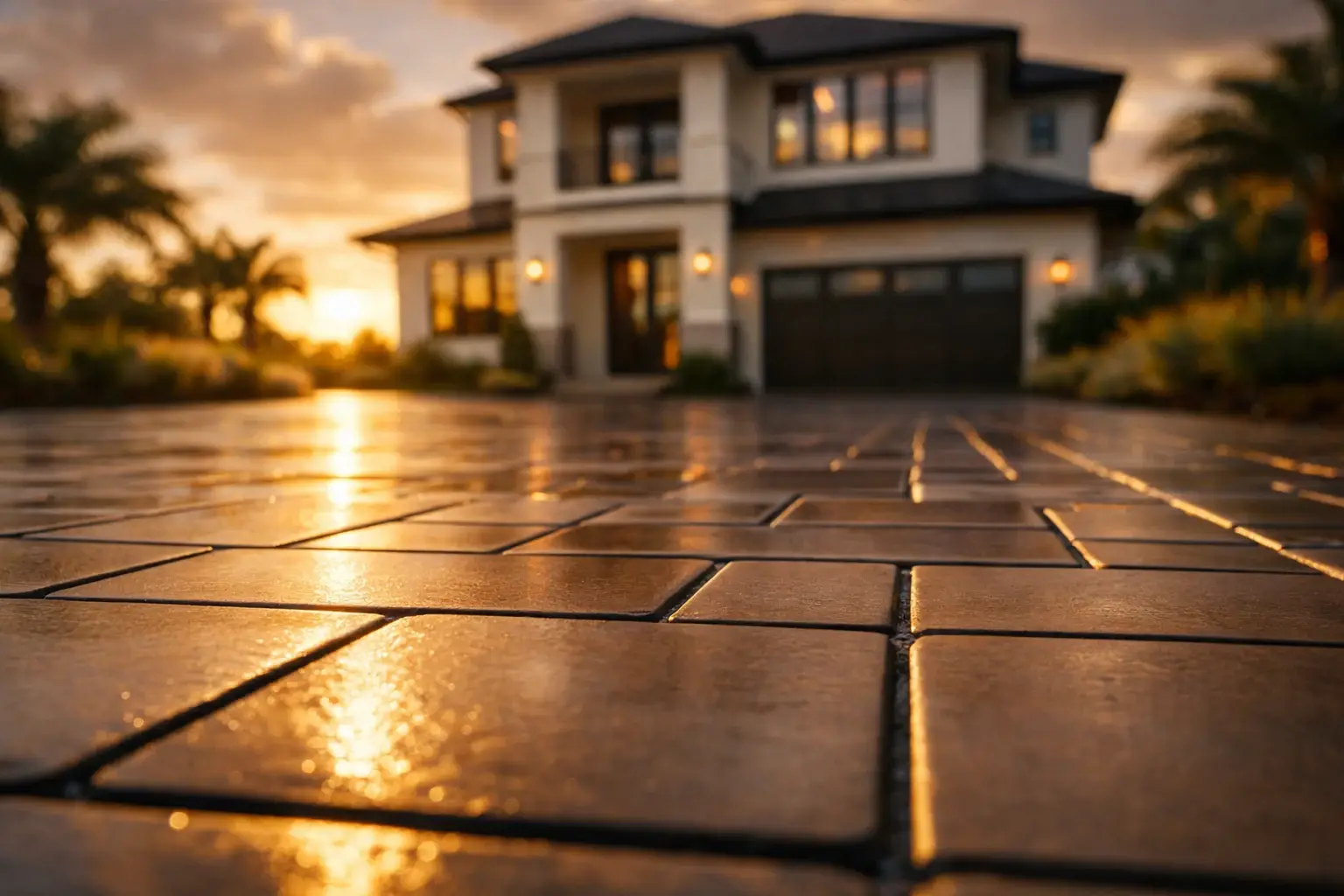
Paver courtyards do double duty at the beach — parking pad on Friday, party floor on Saturday. They are cleaned at reduced pressure to keep the jointing sand where it belongs, because a joint emptied by an aggressive wand lets the field shift and rock, and wind-blown beach sand that replaces lost joint sand does not lock the way a proper angular joint sand does. Where joints have thinned we recommend a proper sanding and sealing rather than a cosmetic wash. Pool decks get finish-surface treatment with runoff directed away from the pool. See pool deck cleaning and patios and lanais.
Why We Refuse Polymeric Sand at the Beach
Polymeric sand — the binder-hardened joint product sold everywhere in Florida — fails fastest exactly where the Beaches live: heat, humidity, salt-laden moisture and daily irrigation defeat the binder, and the residue hazes and crusts across the paver face before cracking out of the joint. We do not use it, here or anywhere. We joint with angular sand, whose sharp-edged grains lock mechanically under load and keep the interlock without asking a plastic binder to survive an environment that dissolves patio furniture.
Rust, Fastener Bleed and Irrigation Staining
Salt accelerates corrosion, and corroding metal writes on concrete: orange trails under railing posts, streaks below air-conditioning stands, rings where furniture feet sit through a season. Irrigation drawing from wells adds its own iron staining. None of that is a pressure problem — force merely cleans the surface around the stain — so we treat it chemically as its own line of work. See rust and stain removal.
Wood Walkovers, Decks and Fences
Beach wood lives a hard life — UV, salt and sand abrasion open the grain years before inland wood shows the same wear. High pressure furs and splinters it. We clean beach wood at low pressure, with the grain, letting the solution do the work, and we will tell you when a board has passed the point where cleaning helps and refinishing is the honest answer. See wood deck cleaning and fence cleaning. Dune walkovers and anything crossing protected vegetation are assessed conservatively — runoff and access are planned around the dune, never over it.
What Pressure Never Touches
The dividing line matters more at the beach, not less, because coastal materials are already working harder. We do not pressure wash asphalt shingle roofs — pressure strips the granules that protect the shingle, and coastal roofs are already surrendering granules to wind and salt; they get soft washing. We do not pressure wash painted or stained beach siding, stucco, or fibre-cement — those walls get soft washing too. We do not pressure wash window screens, screen enclosures, or any assembly where salt has already compromised seams and sealant. Force on a corroded fastener line is how panels end up in the yard.
Built for the Way the Beaches Actually Live
Jacksonville Beach properties work harder in public than most homes. Many are second homes or vacation rentals where the driveway and walk are the first thing a guest photographs; others sit on walk-street lots where the entire neighborhood passes the front walk daily. We schedule around turnovers and gatherings, arrive when we say we will, and leave hardscape that reads clean from the sidewalk — because at the beach, the sidewalk is where everyone is standing.
- Walk and assess. Every surface identified and its condition documented, with corrosion-weakened fittings flagged before water touches them.
- Treat the biology. Growth is killed at the root, not just knocked down, so the result outlasts the season.
- Clean at matched pressure. Surface cleaner on concrete, reduced pressure on pavers, hand work at edges and thresholds.
- Flush the salt. A full freshwater rinse, with runoff directed away from pools, beds and the dune line.
- Walk it with you. Finished means inspected in daylight against the written scope — nothing less.
Every visit is fully insured and backed by our written guarantee. For the split between force and chemistry on a coastal property, see pressure washing vs. soft washing.
Questions Jacksonville Beach Owners Ask
How often does beach hardscape need cleaning?
More often than inland, and the closer to the ocean the shorter the cycle. Salt film builds continuously even when biological growth is slow, so oceanside properties usually benefit from a steadier rhythm of lighter maintenance rather than one heavy annual reset. We set the schedule from where your property actually sits, not from a generic calendar.
Can you work around vacation-rental turnovers?
Yes. Exterior work at a rental is booked against the turnover window so guests never arrive to hoses on the walk. Many owners pair exterior visits with our housekeeping-side turnover service so the whole property resets at once.
Will pressure washing get rid of the rust stains under my railings?
Not by itself — rust is a chemical stain, and pressure alone brightens the concrete around it while leaving the orange behind. We treat rust as a dedicated step with the correct chemistry, then clean the surrounding surface so the repair blends in.
Is the salt film actually harmful, or just dull-looking?
Both. On concrete and pavers it is mostly cosmetic, but salt held against metal — railing bases, fixture mounts, garage tracks, fasteners — keeps corrosion running year-round. A proper freshwater flush is the simplest protection there is for everything metal that touches your hardscape.
Do you clean storefronts and commercial walks at the Beaches?
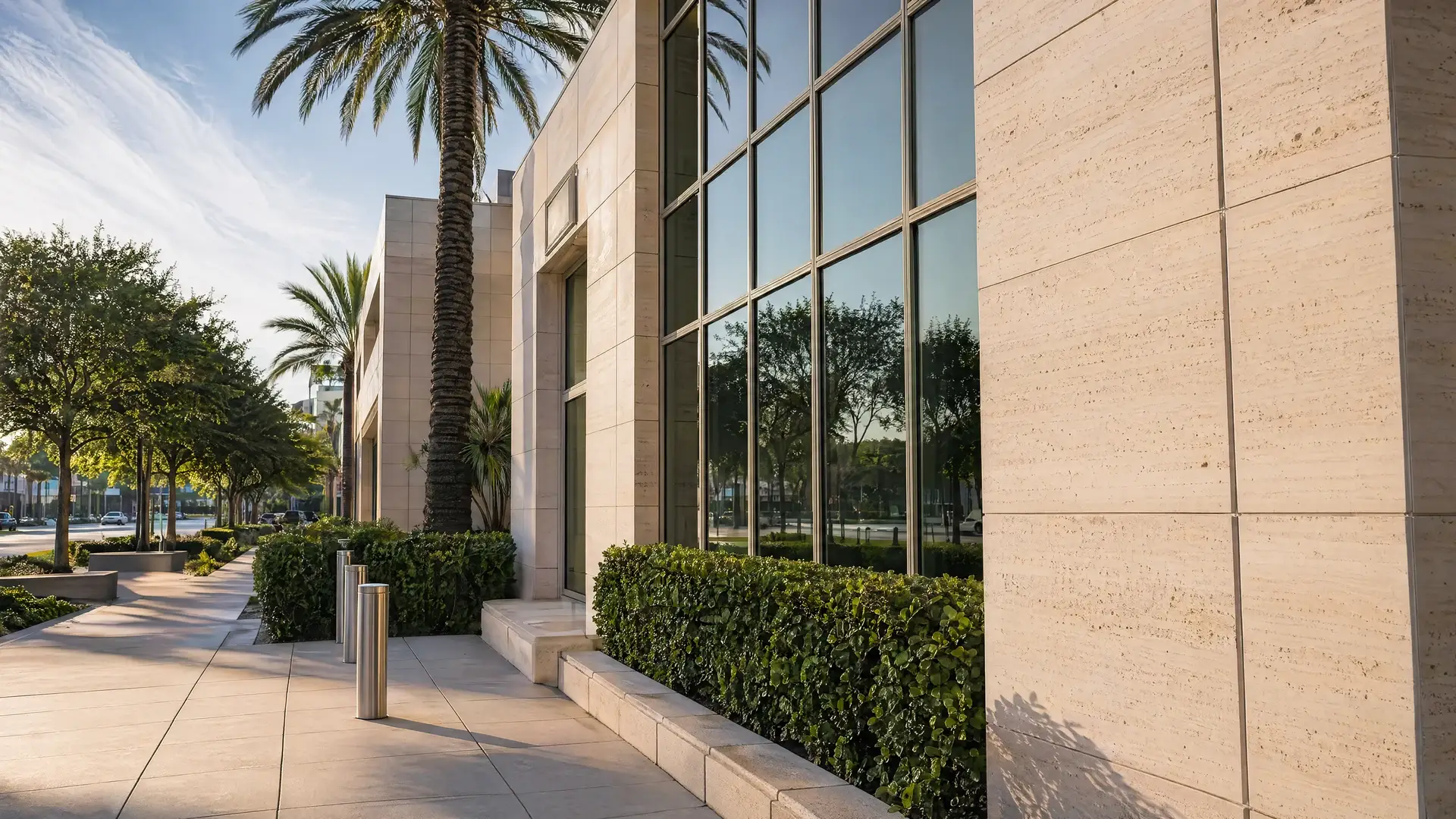
Yes — sidewalks, entries, patios and building exteriors for restaurants and storefronts, scheduled outside business hours. See storefront cleaning and commercial exterior cleaning.
What will it cost?
It depends on the surfaces, their condition and their exposure — a salt-side paver courtyard is a different job from a westside concrete drive. We look first, then put a firm figure in writing before anything is scheduled.
Related Services and Areas
The Gold Standard, Every Time.
Bring Back the Beach House Finish
We walk the property, read its exposure, and set a maintenance rhythm that fits life this close to the ocean.
2026 Best of Florida Winner — Exterior Cleaning Services · BBB Rated A · Serving St. Johns, Duval & Nassau Counties · More than a century of combined expertise.