** WARNING: connection is not using a post-quantum key exchange algorithm.
** This session may be vulnerable to “store now, decrypt later” attacks.
** The server may need to be upgraded. See https://openssh.com/pq.html
Travertine,
Preserved The Way It Was Built To Be.
·
Manufacturer-Trained
·
3–5+ Year Performance
·
Screen-Environment Optimized
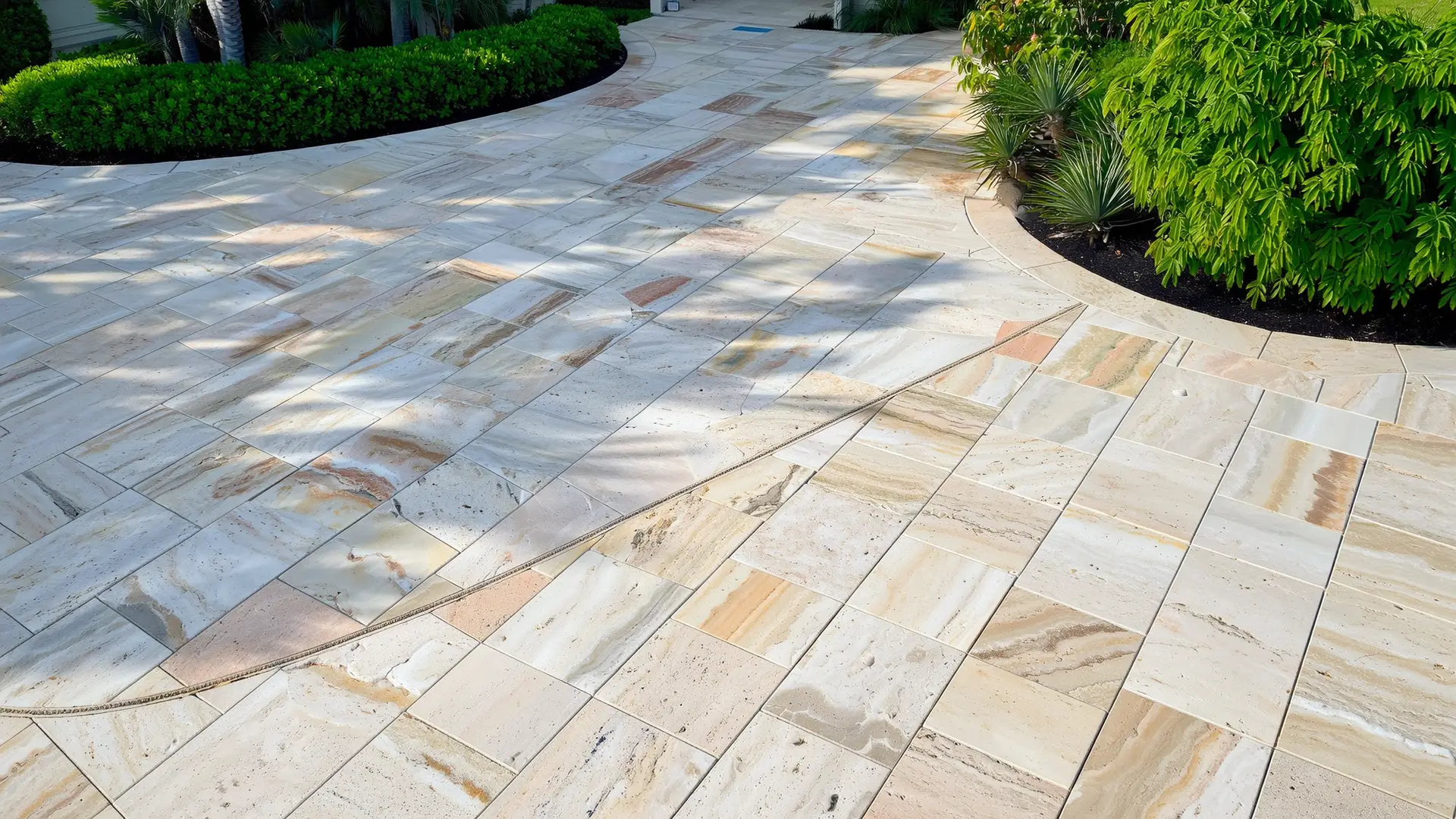
Travertine Is Not A Paver. It Is A Living Calcium Carbonate.
Travertine is formed by mineral springs over tens of thousands of years. Its surface looks like stone but behaves like a sponge — open capillary pores, a soft calcium-carbonate matrix, and a slow mineral release that continues long after it has been set into your deck. The chemistry of travertine is the reason it feels cool underfoot in August. It is also the reason most sealers fail within eighteen months.
Low-pH pool water, salt chlorinators, sunscreen, iron from well systems, and the humidity trapped beneath a screen enclosure each react with the stone in a different way. Travertine must be sealed with a chemistry that respects what it is: porous, alkaline, and permeable to moisture vapor from below.
A pool deck sealed incorrectly looks good for one season. A pool deck sealed correctly looks honest for five. The work that follows is the difference — and when a job requires a manufacturer-rated system we specify Laticrete-grade sealer systems, with joint aggregates that meet the ASTM C144 fine-aggregate standard.
Four Truths The Industry Rarely Explains.
Most deck sealers were engineered for concrete pavers. Travertine is a different material, and it requires a different discipline. These are the four truths that govern every job we accept.
Calcium carbonate reacts with low-pH pool water — the sealer must buffer the stone, not trap acid against it.
Travertine must be able to release moisture vapor from below, or the sealer will blush, cloud, and delaminate.
Existing failing sealer must be chemically removed — not sandblasted, not ground off — so the capillaries reopen clean.
A screen enclosure extends the performance envelope significantly — less UV, fewer organics, a measurably longer seal life.
A Two-Stage Chemistry Built Specifically For Travertine.
Trident is the specialty system FCPE crews are manufacturer-trained to install. It is not a consumer-grade sealer. It is two coordinated chemistries, applied in sequence, each engineered to do one thing perfectly.
A Deep-Penetrating Defense, Invisible To The Eye.
Sea Wall is a siliconate-based penetrating sealer that travels into the capillary network of the travertine and bonds chemically to the calcium carbonate at depth. It does not sit on top of the stone. It becomes part of it — lining the pores with a hydrophobic barrier that repels chlorine, salt water, iron, and organic staining before they can take hold.
Because Sea Wall works from the inside out, the travertine retains its honest, matte character. There is no film, no wet look, no trapped moisture. The stone still breathes. The stone still feels like stone.
This is the quiet half of the system — the one that does its work where you will never see it, and which is the reason the visible finish of Stage Two will still be there in year five.

The Finish Coat That Deepens, Defends, And Disappears.
Jetty is the surface-level half of the Trident system. It layers over Sea Wall once the stone is fully cured and delivers three things: UV stability, a quiet enrichment of the natural tonality of the travertine, and a low-sheen natural finish that never reads as plastic or glossy.
Jetty is engineered to let water vapor pass through it while still stopping liquid water, oils, and organics at the surface. That single property — breathability — is why Jetty will not blush, whiten, or fog in the way film-forming consumer sealers do when they are applied to porous stone.
On a travertine deck under a screen enclosure, Jetty is designed to hold its performance envelope for three to five years and beyond, with only a soft rinse required to maintain it.
The Single Most Skipped Step In The Industry.
Ninety percent of failed travertine sealer jobs trace back to a single shortcut: a crew sealed on top of a deck that still had residue of an old, failing sealer. The new product cannot bond to calcium carbonate if it is bonding to an old chemistry instead. Within a single season, it clouds, peels, and flakes.
FCPE crews never seal until the stone is chemically clean. We use Tidal Wave, a specialty stripper that dissolves old sealer residue without scarring the stone, followed by Rip Tide, a neutralizer that balances the pH of the substrate back to its native alkaline state. Only then is the deck deep-cleaned and the pores reopened for Sea Wall.
It is slower. It is more expensive. It is the difference between a five-year finish and a ten-month finish.
A Project Paced By The Chemistry, Not The Calendar.
We do not compress the schedule to fit a weekend. Travertine must dry from the inside out before Stage One can bond. These are the four days that produce a finish that lasts.
Strip, Neutralize, Deep Clean
Tidal Wave dissolves existing sealer residue. Rip Tide neutralizes the stone chemistry. A deep low-pressure rinse opens the capillary pores and clears organic staining. The deck is left bare to begin its dry cycle.
Moisture Release
Travertine must breathe. The deck is protected but undisturbed for forty-eight hours so trapped moisture can fully release from below. No foot traffic, no pets, no furniture. This window is non-negotiable — it is the reason Stage One bonds properly.
Stage 1, Stage 2, Walkthrough
Sea Wall is applied first and allowed to cure through the pore network. Jetty follows once the surface is dry to touch. We walk the finished deck with you in person, demonstrate the water-repellency in real time, and hand off a written aftercare plan. If weather intervenes, we reschedule Day Four at no cost.
Transparent, Bracketed, And Priced Like Stonework Should Be.
Custom-priced per surface type and size.
Typical travertine pool deck pricing, full Trident Two-Stage system installed.
$1,000
Job floor. Smaller decks scale up to this minimum to reflect the full chemistry and labor footprint.
15% To Secure
Reserves your install window on the crew calendar. Fully applied to the final invoice.
Due On Completion
Paid after your in-person walkthrough. Quote remains valid for five calendar days from issue.

Three To Five Years. Simple Care. Honest Stone.
Under a screen enclosure in Northeast Florida, a properly installed Trident finish typically holds its performance envelope for three to five years and beyond. On open-air decks, expect the lower end of that window and plan a Stage Two refresh on year three.
The aftercare plan we leave at the end of Day Four is simple. It is designed to be followed by anyone, and it extends the finish more than any single step we perform on site.
- 01Soft rinse the deck monthly with plain water to clear pollen, salt, and organic debris.
- 02Use a pH-neutral stone cleaner for any spot cleaning — never an acid, never a citrus, never bleach.
- 03Rinse off sunscreen, iron, and pool chemistry spills the same day they land on the stone.
- 04Felt pads beneath furniture. Lift, do not drag, when repositioning anything metal.
Begin With An Assessment.
Every travertine project starts with a site visit — we read the stone, photograph the failing sealer, measure the deck, and bracket the work before we ever quote.
Request Your Assessment →
The Gold Standard, Every Time.
Ponte Vedra Beach
Queens Harbour
Marsh Landing
Sawgrass
Atlantic Beach
Jacksonville Beach
Amelia Island
St. Augustine