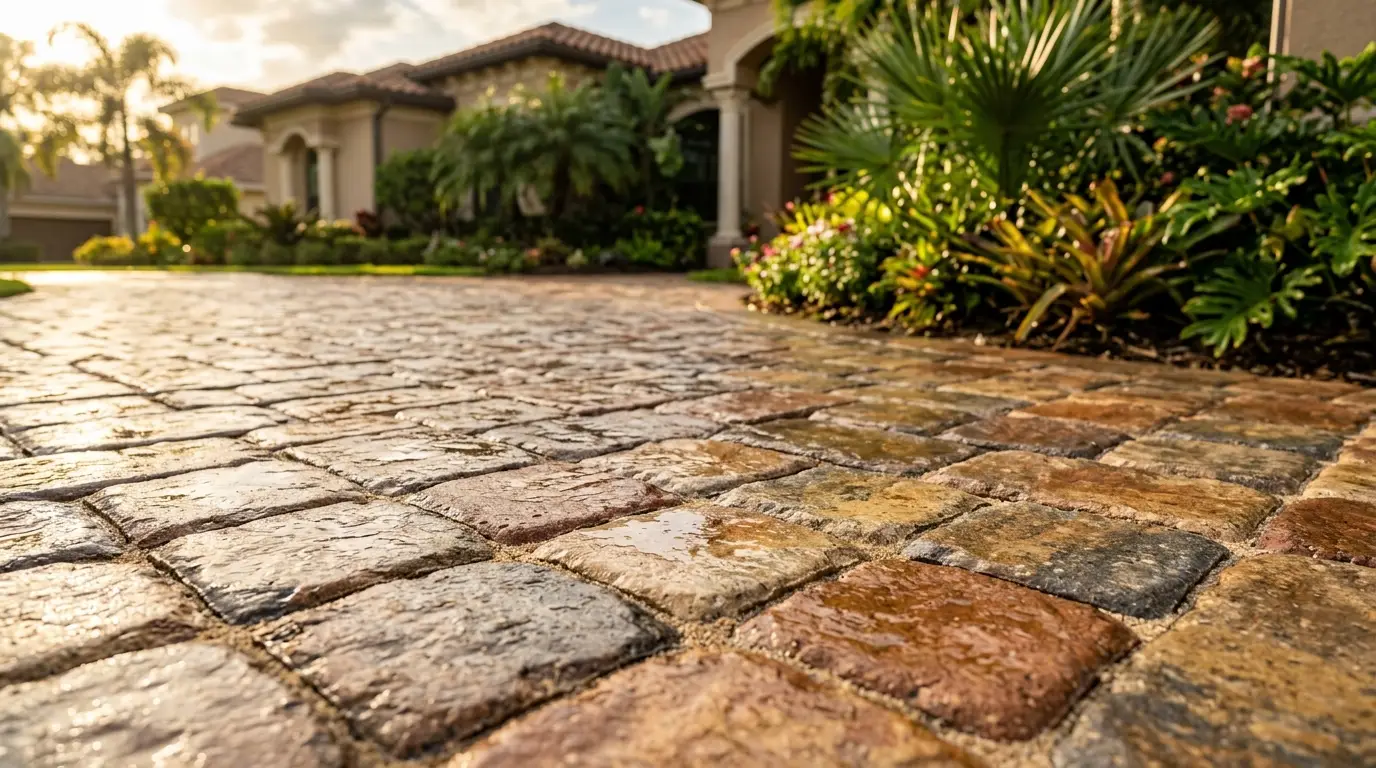
Paver Sealing in Florida: When, Why, and How Often
Last updated: April 2026 · First Coast Property Experts
Florida pavers take more abuse than pavers anywhere else in the country. Between UV exposure that rivals Arizona, rainfall totals that top 50 inches per year, and humidity levels that rarely drop below 60%, the conditions here break down unsealed pavers fast. Sealing protects them. But the details matter — when you seal, what you seal with, and how the surface is prepped beforehand all determine whether you get 3 years of protection or 3 months of buyer’s remorse.
Ready for a quote? Our team serves St. Johns, Duval, and Nassau counties with the Gold Standard, every time. Request your free estimate or explore paver sealing.
This guide covers everything a homeowner in Northeast Florida needs to know about paver sealing, from timing to maintenance to red flags when hiring a contractor.
Why Seal Pavers in the First Place?
Pavers are durable by design. Concrete pavers, brick pavers, and natural stone like travertine and bluestone can last decades. But durability and appearance are two different things. Without sealer, here’s what happens to pavers in Florida:
- Color fades. UV rays bleach pigment from concrete pavers within 12-18 months. That rich rust, charcoal, or sandstone color you chose at the supply yard gradually shifts to a washed-out gray.
- Stains absorb. Unsealed pavers are porous. Oil drips from cars, rust from fertilizer, leaf tannins, and pool chemical splash all soak in and become permanent. Sealed pavers give you a window to clean stains before they set.
- Joint sand erodes. Rain, foot traffic, and pressure washing wash joint sand out from between pavers. Once the sand is gone, pavers shift, weeds colonize the gaps, and fire ants build mounds in the joints.
- Biological growth takes hold. Mold, mildew, algae, and lichen grow on any moist, porous surface. Shaded pavers in Northeast Florida can turn green within a single rainy season.
- Efflorescence appears. That white, chalky residue on concrete pavers is mineral salt migrating to the surface. Sealer blocks this migration once the initial efflorescence has been cleaned.
Sealing addresses all five of these issues simultaneously. A quality sealer enhances color, repels stains, stabilizes joint sand, inhibits biological growth, and blocks efflorescence. For the cost — typically a fraction of what the pavers themselves cost to install , it’s one of the best investments a Florida homeowner can make in their hardscaping.
When to Seal: Timing Matters More Than You Think
New Paver Installations
If your pavers were just installed, resist the urge to seal them immediately. New concrete pavers need 60 to 90 days to cure and release efflorescence naturally. Sealing over efflorescence traps those mineral deposits under the sealer, creating a cloudy, white haze that’s difficult and expensive to correct.
After the 60-90 day window, clean the pavers thoroughly and seal them. The longer you wait beyond that, the more UV damage and staining occurs on the unprotected surface.
Existing Pavers That Have Never Been Sealed
It’s never too late. We seal pavers that are 5, 10, even 15+ years old. The process starts with a thorough cleaning , pressure washing to remove all biological growth, stains, and debris , followed by joint sand replacement and then sealer application. Older pavers that have lost their color often look dramatically different once sealed, because quality sealers enhance and deepen the original pigment.
Re-Sealing Previously Sealed Pavers
Plan to re-seal every 2 to 3 years. The exact interval depends on:
- Traffic level. A driveway that handles two cars daily wears faster than a backyard patio.
- Sun exposure. South-facing pavers in full sun degrade sealer faster than shaded areas.
- Sealer type. Water-based acrylics typically last 2-3 years. Solvent-based sealers can extend slightly longer but come with stronger fumes and more environmental restrictions.
- Maintenance. Regular cleaning extends sealer life. Letting debris and organic matter sit accelerates breakdown.
How to tell it’s time: water no longer beads on the surface. Spread a few drops of water on the pavers. If it soaks in instead of sitting on top, the sealer has worn through.
Best Time of Year to Seal Pavers in Florida
October through May. That’s the window.
Paver sealer needs 24 to 48 hours to cure without rain. Florida’s summer storm pattern , clear mornings followed by afternoon thunderstorms almost daily from June through September , makes that 48-hour dry window unreliable. It’s not impossible to seal in summer, but it requires monitoring weather forecasts closely and accepting the risk of a rained-on seal job.
The ideal conditions are:
- No rain in the forecast for 48 hours
- Temperatures between 50F and 90F
- Low to moderate humidity
- Pavers completely dry before application
In Northeast Florida, that describes most days between October and May. We schedule the bulk of our paver sealing work during this window for exactly that reason.
The Sealing Process: What Proper Paver Sealing Looks Like
A seal job is only as good as the prep work. Skipping steps here shows up fast , peeling sealer, trapped dirt, uneven sheen, and premature failure.
Step 1: Cleaning
Every paver sealing project starts with a full pressure wash. We use surface cleaners for flat areas and wand work for edges, borders, and tight spots. The goal is removing 100% of biological growth, stains, debris, and any remaining old sealer that’s flaking or failing.
For pavers with heavy algae or mold, we pre-treat with a cleaning solution before pressure washing. This kills growth at the root so it doesn’t return under the new sealer.
Step 2: Joint Sand Replacement
Pressure washing removes loose and deteriorated joint sand. Before sealing, all joints need to be filled to the proper level with fresh joint angular sand. This sand gets packed into every joint, leveled, and compacted.
Full joint sand is critical. The sealer bonds to both the paver surface and the joint sand, locking everything together. Empty or low joints mean the sealer bridges the gap unsupported, which leads to cracking and peeling.
Step 3: Drying
Pavers must be completely dry before sealer goes on. In Florida’s humidity, that usually means waiting 24 hours after cleaning. Applying sealer to damp pavers causes whitening, bubbling, and adhesion failure.
Step 4: Sealer Application
We apply sealer using low-pressure sprayers for even coverage, followed by back-rolling to work the sealer into the paver surface and joint sand. Two thin coats outperform one thick coat , better adhesion, more even sheen, and less risk of bubbling or pooling.
Step 5: Curing
After application, the sealed surface needs 24-48 hours of no foot traffic, no water, and no rain. Full vehicular traffic should wait 72 hours. This is why weather forecasting matters so much in Florida.
Wet Look vs. Matte vs. Semi-Gloss: Choosing Your Finish
Sealer finish is a personal preference, but there are practical considerations:
- Wet look (high gloss): Deepest color enhancement. Makes pavers look permanently wet. Popular on pool decks and patios where the rich, saturated appearance adds to the outdoor living aesthetic. Shows tire marks more readily on driveways.
- Semi-gloss: A middle ground. Enhances color without the mirror-like shine. Hides imperfections better than high gloss. This is our most-requested finish across St. Johns County.
- Matte (natural look): Minimal sheen. Protects the pavers without changing their appearance. Good for homeowners who want protection without the “sealed” look. Also the most forgiving finish for DIY application.
All three finishes provide the same level of protection. The difference is purely aesthetic. We bring sealer samples to every estimate so homeowners can see the finish options on their actual pavers before committing.
Common Paver Sealing Mistakes
We fix a lot of seal jobs done by other companies or by homeowners who bought sealer at the hardware store and went for it. The most common problems:
Sealing Over Dirty Pavers
If the surface isn’t perfectly clean, the sealer locks in whatever is on it. Dirt, algae, and stains become permanently sealed under a clear coat. There’s no fixing this short of stripping and starting over.
Applying Sealer Too Thick
More is not better. Thick sealer application causes bubbling, white hazing, and a tacky surface that peels within months. Two thin, even coats create a stronger bond than one heavy coat.
Sealing Wet Pavers
This is the most common DIY mistake. The pavers look dry on the surface, but moisture is trapped in the pores. The sealer traps that moisture, which pushes back up as white spots or cloudiness as it tries to evaporate. In Florida, where morning dew is heavy, patience with dry time is essential.
Using the Wrong Sealer
Big box store sealers and professional-grade sealers are not the same product. Consumer sealers are often diluted, use lower-quality resins, and don’t hold up to Florida’s UV and rain exposure. We use commercial-grade sealers specifically formulated for the Florida climate. The Interlocking Concrete Pavement Institute publishes guidelines on sealer selection that most consumer products don’t meet.
Skipping Joint Sand
Sealing pavers with empty or low joint sand defeats half the purpose. The sealer is supposed to lock that sand in place, stabilizing the entire paver field. Without sand in the joints, you get weed growth, ant infiltration, and pavers that shift underfoot.
How Long Does Paver Sealing Take?
For a typical driveway and walkway (500-800 sq ft), expect:
- Day 1: Pressure washing and joint sand application
- Day 2: Drying time (no work on site)
- Day 3: Sealer application (2 coats)
- Days 4-5: Curing (no foot or vehicle traffic)
Larger projects , full pool decks, extensive patios, long driveways , may add a day to cleaning and sealing. We schedule every project with weather buffers built in.
Paver Sealing by Surface Type
Different paver materials require different approaches:
- Concrete pavers: The most common type in NE Florida. Standard sealing process as described above. Respond well to both water-based and solvent-based sealers.
- Travertine: Natural stone that requires a penetrating sealer rather than a topical film. Travertine sealing is its own specialty , the stone is porous and sensitive to acidic cleaners.
- Bluestone: Dense natural stone. Less porous than travertine but still benefits from sealing, especially in pool deck applications. Bluestone sealing protects against chlorine damage and UV fading.
- Brick: Old-growth clay brick is denser and less porous than modern brick pavers. Both benefit from sealing, but modern brick pavers absorb more sealer and may need an extra coat.
The Cost Question
Paver sealing costs depend on total square footage, paver condition, accessibility, and whether joint sand replacement is needed (it almost always is). For a ballpark: sealing costs a fraction of paver installation per square foot. Given that paver installation runs $12-$25+ per square foot in Northeast Florida, sealing every 2-3 years is inexpensive insurance on a significant investment.
We provide free, detailed estimates that break down every line item. No surprises.
Maintaining Sealed Pavers
Once your pavers are sealed, a little maintenance extends the sealer’s life significantly:
- Blow debris regularly. Leaves, pine needles, and organic matter trap moisture against the sealer and accelerate breakdown.
- Clean stains quickly. Oil, rust, and food stains are easier to remove from sealed surfaces, but don’t wait weeks.
- Rinse periodically. A garden hose rinse every few weeks removes dust and pollen that can dull the finish.
- Avoid harsh chemicals. Muriatic acid, undiluted bleach, and industrial degreasers can damage sealer. Use pH-neutral cleaners.
Get Your Pavers Sealed Right the First Time
First Coast Property Experts has sealed thousands of square feet of pavers across Ponte Vedra, Nocatee, St. Augustine, Jacksonville, and Fernandina Beach. We handle the full process , cleaning, joint sand replacement, sealer application, and follow-up inspection , with the same attention to detail on every project.
Request a free estimate for paver sealing or call us at (904) 466-1622. The Gold Standard, Every Time.