
Exterior Cleaning Services
Roof Cleaning at the Beaches
Jacksonville Beach · Atlantic Beach · Neptune Beach
A roof three blocks from the Atlantic lives a different life than one in Mandarin. Salt, wind-driven rain and constant humidity change what grows on it — and change what may safely be used to take it off.
The Salt Belt Is Its Own Roofing Climate
Jacksonville Beach, Neptune Beach and Atlantic Beach sit on a narrow strip between the Atlantic and the Intracoastal, and that geography does something specific to a roof. Onshore wind carries a fine saline aerosol inland day and night. It settles on every surface, and because salt is hygroscopic — it pulls moisture out of the air and holds it — a beach roof stays damp longer than an inland roof under identical weather.
The practical consequence is that the beaches get everything the rest of Duval County gets, plus a mineral layer on top of it, plus accelerated corrosion anywhere metal is exposed. The roof algae that streaks inland roofs grows here too, and the salt film that holds moisture against the surface helps it along.
The other difference is tree cover, or the lack of it. Inland Jacksonville roofs sit under live-oak canopy, which means shade, organic debris and lichen. At the beaches the canopy is sparser and the exposure is greater, so lichen is less of a problem and ultraviolet load, salt deposition and wind-driven sand are more of one. That shifts what needs to happen on the roof, and it is why this is a separate page rather than the same page with the town name swapped out.
What Is Actually Streaking a Beach Roof
The black running down the plane of the roof is Gloeocapsa magma, a blue-green algae that feeds on the limestone filler blended into asphalt shingles and shields itself from ultraviolet light with a dark pigmented sheath. It starts on the slope that dries slowest — usually the north face — and runs downward as rainfall carries spores with it.
Layered over that at the beaches you get a pale mineral haze from salt deposition, and, on any exposed metal, the beginnings of corrosion staining. Ridge vents, valley metal, drip edge, flashing, roof-mounted fasteners and vent boots are all places where the salt belt shows its work first. When we assess a beach roof we are looking at all three problems, not just the one that is visible from the street.
Why It Costs You Roof Life
Algae holds moisture against the shingle and works its way between the granules that shield the asphalt from ultraviolet light. Salt keeps the surface wet for longer, extending the window in which that happens. Once granule coverage thins, the asphalt oxidizes, hardens and cracks. A roof that keeps its granules reaches its rated life; a roof that loses them does not. At the beaches that clock runs faster than it does inland.
Never a Pressure Washer — And Here It Matters Even More
The Asphalt Roofing Manufacturers Association, the trade body of the companies that make asphalt shingles, publishes guidance recommending low-pressure application of an appropriate cleaning solution for algae removal. Pressure washing is not a recommended cleaning method for asphalt shingles, and most manufacturers’ limited warranties exclude damage caused by improper maintenance.
On the barrier island the case is even stronger, for two reasons. First, beach roofs are more frequently metal or tile, both of which depend entirely on a coating or a brittle body that pressure and abrasive products destroy. Second, wind-driven sand has already been working on these surfaces for years — a beach roof arrives at the cleaning with less margin than an inland one, and there is no reason to spend the rest of it on a pressure washer.
Everything we do on a roof is soft washing. Pressure at the surface is comparable to a garden hose. A purpose-formulated solution is applied, given the dwell time it needs to kill the colony at its root, and gently rinsed. Because the organism is killed rather than knocked loose, the result holds for years. Full detail on the method is on our Jacksonville roof cleaning page and our main roof cleaning service.
Beach Roof Types, and What Each One Needs
Standing-Seam and Metal Roofing
Common on the newer coastal contemporary builds through Jacksonville Beach and on the renovated cottages of Neptune Beach and Atlantic Beach, and popular here for good reason — metal handles wind and salt better than most alternatives when it is maintained. Its protection is its factory coating, and abrasive or acidic products strip that coating permanently, at which point the panel begins to corrode. Metal gets chemistry matched to the finish and nothing mechanical. Fasteners and panel laps are inspected for the corrosion staining that signals a failing washer.
Concrete and Flat Tile
Widespread on the 1990s and 2000s beach stock. Tile is hard but brittle, and it is fastened over battens and underlayment that must not be disturbed. Foot traffic is the genuine risk, so we work from edges, ladders and walk boards wherever the geometry allows, and we treat rather than scour. Salt accumulation in the tile’s surface texture takes a longer dwell than an inland tile roof does.
Architectural Asphalt Shingle
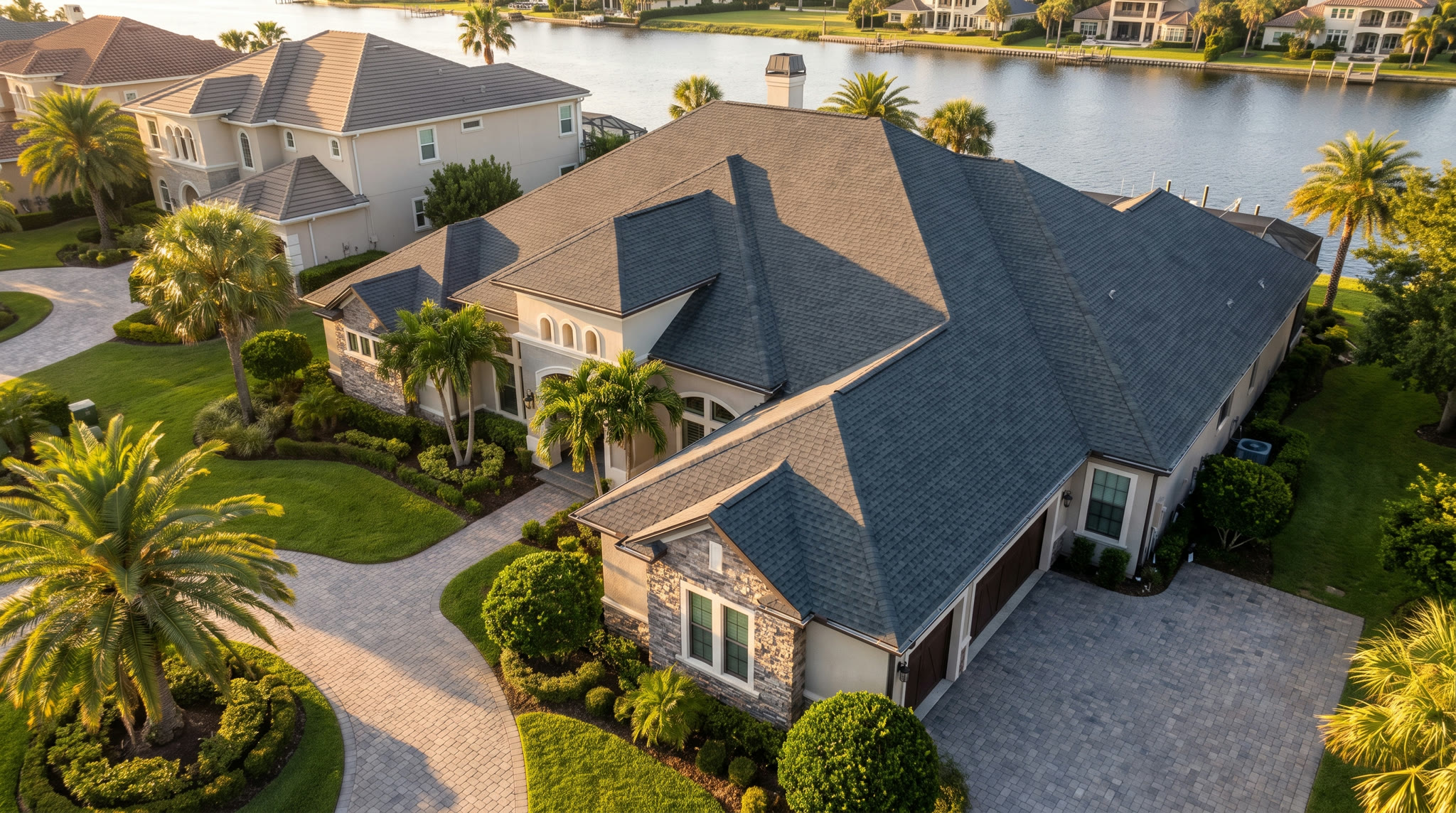
Still the most common roof across all three beach towns. Soft wash only, at the lowest working pressure, with landscaping protected and runoff directed away from the ocean-facing beds that are already under salt stress. On homes within a few blocks of the dune line, expect the interval between cleanings to be shorter than an inland home of the same age.
Older Beach Cottages
The mid-century cottage stock through Neptune Beach and the older streets of Atlantic Beach often carries decades of layered work — original wood decking, aged flashing, sometimes a low-slope porch roof grafted onto a pitched main. These get the most conservative treatment we offer and the most honest assessment. If a roof is at the end of its life we will say so rather than sell you a cleaning that will not change its outcome.
Timing It Around the Coast’s Calendar
Two dates drive scheduling at the beaches. The first is storm season: from June through November, a clean roof and clear valleys and gutters are simply better prepared, and the assessment we do while we are up there frequently catches a lifted shingle, a failing vent boot or a corroded fastener while it is still a small item. The second is the rental calendar. Beach properties that are rented short-term face appearance standards from management companies and guests alike, and the practical window for exterior work is the gap between bookings — we schedule to it.
See the Northeast Florida exterior cleaning calendar for the full year, and rental turnover cleaning if the interior needs the same attention between guests.
Questions Beach Homeowners Ask
How often should a beach roof be cleaned?
More often than an inland one. Many Jacksonville Beach, Neptune Beach and Atlantic Beach roofs want attention on a roughly two-year cycle, and homes within a few blocks of the dune line sometimes sooner. Salt holds moisture on the surface, and moisture is what the algae needs.
Will roof cleaning remove salt haze as well as the black streaks?
Yes — the treatment addresses the mineral film alongside the biological growth. What it cannot reverse is corrosion that has already gone into exposed metal. We will point that out during the assessment rather than after.
I have a metal roof. Is cleaning safe?
Yes, with the right chemistry. The coating is what protects a metal roof, so abrasive pads and acidic products are never used on it. We match the solution to the finish and rinse at low pressure.
Can you work around a short-term rental schedule?
Yes. Tell us the gap between bookings and we will work to it. Exterior work at the beaches is routinely scheduled into turnover windows.
Do you also clean the house, windows and driveway while you are here?
Almost always — and in that order, roof first so nothing washes down onto finished work. See house washing, exterior window cleaning and pressure washing.
Which beach communities do you serve?
Jacksonville Beach, Neptune Beach and Atlantic Beach across Duval County, plus Ponte Vedra Beach and South Ponte Vedra Beach in St. Johns County and Amelia Island and Fernandina Beach in Nassau County.
Related Services and Areas
The Gold Standard, Every Time.
Get Your Beach Roof Assessed
Salt, algae and corrosion are three different problems on the same roof. We will tell you which ones you have and exactly how each is handled.
Serving St. Johns, Duval & Nassau Counties · BBB Rated A · Five-star rated · More than a century of combined expertise.
correctly.” }
},
{
“@type”: “Question”,
“name”: “Will runoff affect my pool or my neighbor’s yard?”,
“acceptedAnswer”: { “@type”: “Answer”, “text”: “Managing runoff on compact beach lots is a core part of our process. Downspouts are controlled, sensitive areas are pre-wetted and rinsed, and pools are protected during the work.” }
},
{
“@type”: “Question”,
“name”: “How often should a roof be cleaned near the ocean?”,
“acceptedAnswer”: { “@type”: “Answer”, “text”: “Beach roofs generally want attention more often than inland roofs — the salt air recolonizes them faster. After we see your roof’s exposure and shade, we recommend a cadence that fits it.” }
},
{
“@type”: “Question”,
“name”: “Does a clean roof matter for insurance or resale?”,
“acceptedAnswer”: { “@type”: “Answer”, “text”: “Condition is documented in photographs on both fronts, and a streaked roof reads as neglect even when the shingles underneath are sound. We photograph every completed roof so your records show a maintained home.” }
}
]
}
]
}