
Exterior Cleaning Services
Roof Cleaning
in Jacksonville, FL
Black streaks removed by the low-pressure method the shingle manufacturers themselves recognize — never by a pressure washer, which strips the granules your roof depends on and voids the warranty that protects it.
Those Black Streaks Are Alive
The dark staining that runs down a Jacksonville roof is not dirt, not soot and not shingle wear. It is a colony of Gloeocapsa magma, a hardy blue-green algae that arrives airborne, lands on the roof, and feeds on the limestone filler that manufacturers blend into asphalt shingles as a weight extender. The algae protects itself from ultraviolet light by producing a dark pigmented sheath — and that sheath is the black you see.
It always begins on the north-facing slope, because that is the slope that dries slowest, and it always runs downward, because rainfall carries spores down the plane of the roof. If the north side of your roof is streaked and the south side is not, that is not a coincidence or a manufacturing defect. That is the organism telling you exactly what it needs to grow.
Northeast Florida gives it everything. Duval County receives more than fifty inches of rain a year, summer nights stay warm and humid, and the St. Johns River, the Intracoastal and the Atlantic keep moisture in the air on almost every side of the city. A Jacksonville roof will grow algae. The only real question is whether it is dealt with while it is cosmetic or after it has started costing service life.
Why It Is Not Only Cosmetic
Algae holds moisture against the shingle surface and keeps it there longer after every rainfall. The pigmented colony also absorbs heat that a clean, reflective granule surface would otherwise send back, which raises attic temperatures and works the roof assembly harder through a Jacksonville summer. Over time the colony’s root structure works between granules and loosens them, and lichen — which frequently follows algae in shaded, canopied neighborhoods — anchors into the asphalt itself and pulls granules away when it is finally removed.
Granules are the roof’s sunscreen. Their entire job is to shield the asphalt beneath from ultraviolet light. When granule coverage thins, the asphalt oxidizes, hardens, and begins to crack. That is why a roof that keeps its granules can reach the end of its rated life, and a roof that loses them does not.
The ARMA Position, and Why We Follow It
The Asphalt Roofing Manufacturers Association — the trade body of the companies that actually make asphalt shingles — publishes technical guidance on algae removal, and it is unambiguous. The recommended approach is a low-pressure application of an appropriate cleaning solution, allowed to dwell and then gently rinsed. Pressure washing is not a recommended cleaning method for asphalt shingles.
What a Pressure Washer Costs You
High pressure strips granules off an asphalt shingle immediately and visibly — the tell is granule accumulation in the gutters and at the downspout discharge afterward. It can also drive water up under the shingle courses and past the underlayment. Beyond the physical damage, most shingle manufacturers’ limited warranties exclude damage caused by improper maintenance, and pressure washing is exactly that. A cheaper roof cleaning that shortens the roof’s life and cancels its warranty is not a saving.
Our roof work is soft washing, full stop. The pressure at the surface is comparable to a garden hose. A purpose-formulated solution is applied, given the dwell time it needs to kill the colony down to its root structure, and then rinsed. Nothing scrubs, nothing scrapes and nothing blasts. Because the organism is killed rather than merely knocked loose, the roof stays clean for years rather than months — and residual staining that remains after the treatment continues to lighten over the following weeks as weathering carries the dead colony away.
Jacksonville Roofs, by Type and by Neighborhood
Architectural Asphalt Shingle
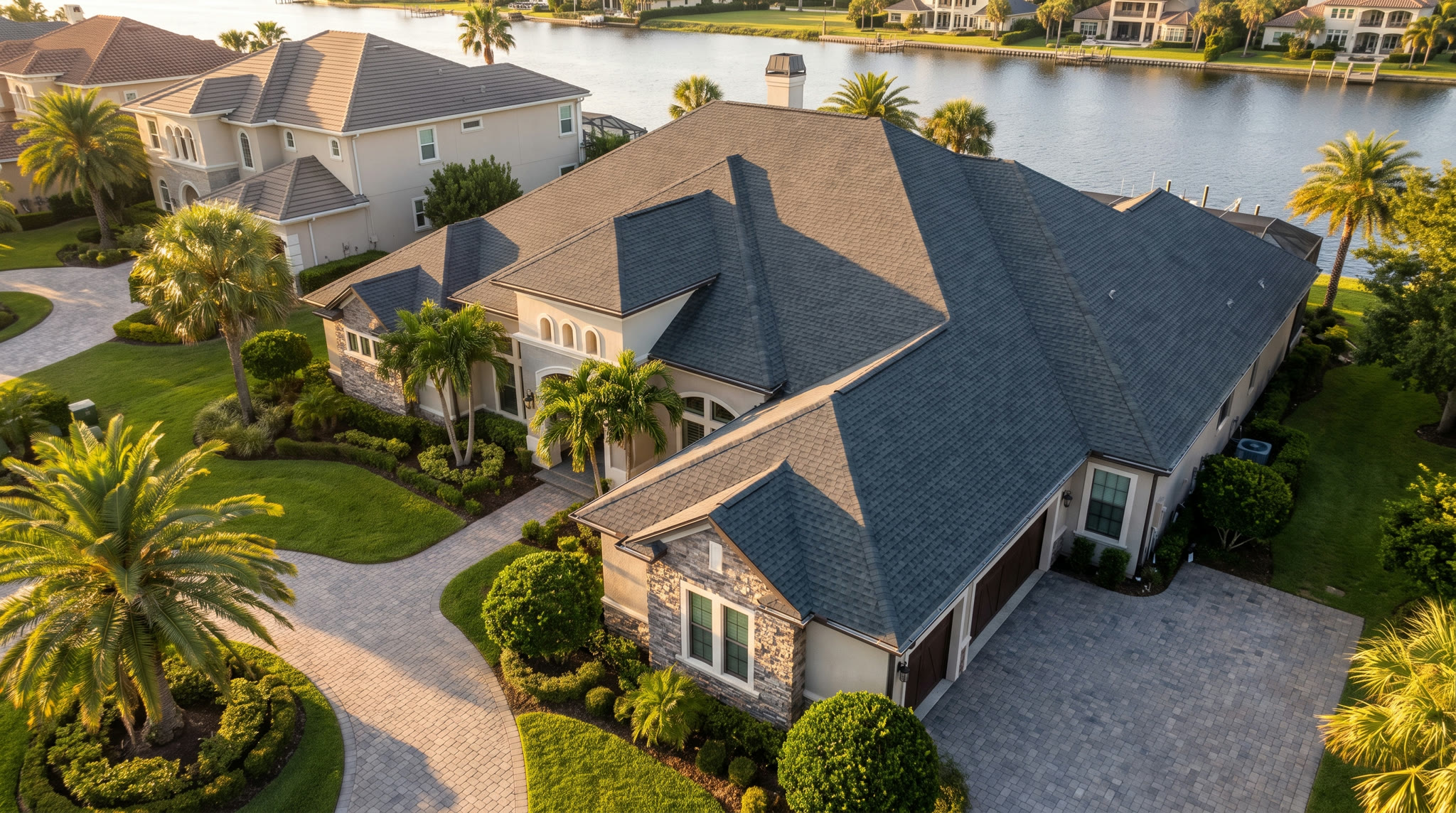
The dominant roof across Southside, Baymeadows, Mandarin, Intracoastal West, Etown and virtually all recent construction. Soft wash only, at the lowest working pressure, with landscaping protected and runoff directed. This is the roof type the ARMA guidance is written about.
Concrete and Clay Barrel Tile
Found on the Mediterranean Revival stock of San Marco and on higher-end newer construction. Tile carries a different risk profile: the tiles themselves are hard, but they are also brittle and they are fastened over battens and underlayment that must not be disturbed. Foot traffic is the real hazard on a tile roof, so we work from the edges and from ladders and walk boards wherever possible, and we treat rather than scour.
Standing-Seam and Metal
Increasingly common on coastal and contemporary builds and on porch and bay roofs across the city. Metal cleans readily but its coating is what protects it, and abrasive or acidic products will dull or strip that coating permanently. It gets a solution matched to the finish. See our full roof cleaning service.
Under the Canopy
In Riverside and Avondale, Ortega and shaded parts of Mandarin, the live-oak canopy adds two problems on top of the algae: constant organic debris in the valleys and gutters, and lichen, which anchors physically into the asphalt. Lichen needs a longer dwell and a gentler hand than algae, and any company that promises to scrub it off in one pass is promising you granule loss.
How the Job Runs
- Assessment first. Roof type, pitch, age, condition, existing damage, problem valleys and any compromised flashing all documented before we start.
- Protection. Foundation planting and beds pre-wetted and protected; downspout discharge points identified and managed; gutters checked.
- Low-pressure application. Solution applied evenly across the plane, worked from the correct direction so nothing runs onto untreated areas.
- Dwell. The step most often cut short. The colony has to be killed, not rinsed.
- Gentle rinse. Low pressure, downward, with runoff directed away from planting, pools and neighbouring property.
- Walk it with you. Results reviewed in daylight, and an honest statement of what will continue to lighten over the following weeks.
Fully insured on every visit, and backed by our guarantee. See how we work and the Northeast Florida exterior cleaning calendar.
Questions Jacksonville Homeowners Ask
How often does a Jacksonville roof need cleaning?
Most asphalt roofs here do well on a two to three year cycle once they have been properly treated. North-facing slopes under heavy canopy in Mandarin, Avondale or Ortega often want it sooner. Roofs that have never been treated usually need one thorough reset and then settle onto a comfortable interval.
Will pressure washing my roof really void the warranty?
Most shingle manufacturers’ limited warranties exclude damage from improper maintenance, and pressure washing an asphalt shingle roof falls squarely inside that exclusion. The ARMA guidance the industry works from recommends low-pressure cleaning, not pressure washing. We do not pressure wash roofs under any circumstances.
My HOA sent a letter about my roof. How quickly can this be handled?
Roof-appearance letters are common in Jacksonville’s master-planned communities, and they usually carry a deadline. Tell us the date on the letter when you call and we will schedule around it, and provide documentation of the completed work.
Will the streaks disappear completely on the day?
Most of the improvement is immediate and dramatic. Some residual shadowing can remain where a colony has been established for years, and that continues to fade over the following weeks as the dead growth weathers away. We will tell you before we start which of those two you should expect.
Is it safe for my plants, my pets and my roof’s underlayment?
Yes, when the protocol is followed. Beds are pre-wetted and protected, runoff is directed, and the pressure used is low enough that nothing is driven under the shingle courses.
Do you clean roofs at the beaches too?
Yes. Salt exposure changes the job, so it has its own page — see roof cleaning at Jacksonville Beach, Atlantic Beach and Neptune Beach.
Related Services and Areas
The Gold Standard, Every Time.
Get Your Jacksonville Roof Assessed
We will tell you what is growing on it, what it has already cost you, and exactly how we will remove it without touching a granule.
Serving St. Johns, Duval & Nassau Counties · BBB Rated A · Five-star rated · More than a century of combined expertise.
the cleaning solution harm my landscaping?”,
“acceptedAnswer”: { “@type”: “Answer”, “text”: “Protecting the plantings is a formal step of our process, not an afterthought. Beds are pre-wetted, kept rinsed during the work, and washed down afterward. Jacksonville’s azaleas, camellias, and old-growth oaks have nothing to fear from a properly run soft wash.” }
},
{
“@type”: “Question”,
“name”: “How often should a Jacksonville roof be cleaned?”,
“acceptedAnswer”: { “@type”: “Answer”, “text”: “Most homes are well served by a soft wash every few years. Heavily shaded roofs recolonize faster than open, sun-struck roofs, so cadence is set with you based on your exposure, not a one-size schedule.” }
},
{
“@type”: “Question”,
“name”: “Can you clean tile and metal roofs too?”,
“acceptedAnswer”: { “@type”: “Answer”, “text”: “Yes. Shingle, concrete and clay tile, and standing-seam metal are all cleaned with the same low-pressure discipline, with the solution and dwell time adjusted to the material. No roof type ever meets a pressure washer.” }
}
]
}
]
}